If you’ve ever spotted a rack of shiny gold bangles priced at $12 each and wondered how they can possibly look so much like the $1,200 version in a department store case — you’re already asking the right question. The short answer: both contain gold, but in wildly different quantities, bonded to the base metal in completely different ways. Gold-plated means a very thin layer of gold (sometimes just a few millionths of an inch thick) has been electrochemically deposited onto an inexpensive base metal like brass or zinc alloy. Solid gold — or even gold-filled, which sits in the middle — means actual gold content runs through or dominates the piece. For a stacked-bangle look, the price gap between these tiers spans hundreds or thousands of dollars per piece. This guide breaks down exactly what you’re buying at each tier, what the longevity math actually looks like, and how to build a smart stack whether your budget is $60 or $6,000.
What “Gold-Plated” Actually Means (And What the FTC Says About It)
The term gold-plated is not a marketing phrase — it’s a regulated category. The U.S. Federal Trade Commission’s Jewelry Guides (16 CFR Part 23) define the thresholds that separate gold-plated, gold-filled, and solid gold, and the distinctions matter enormously for anyone building a bangle stack.
Under FTC Jewelry Guides definitions:
- Gold-plated describes a base metal coated with any gold alloy, with no minimum thickness requirement for the word “plated” alone — though “heavy gold plate” requires at least 100 millionths of an inch (2.5 microns) of gold.
- Gold-filled (or “rolled gold plate”) requires a layer of at least 10k gold that constitutes 1/20th (5%) of the item’s total weight by mass, mechanically bonded under heat and pressure — not electroplated.
- Solid gold (typically 10k, 14k, or 18k) means the entire piece is a gold alloy throughout.
The $10–$25 bangles you’ll find at fast-fashion jewelry retailers or in boutique display piles are almost universally electroplated, often at thicknesses well below 1 micron. The GIA’s educational resource “Gold Jewelry Alloys” notes that electroplating at commercial-fashion volumes frequently deposits layers in the 0.05–0.5 micron range — thin enough that the underlying brass can show through with consistent friction or sweat exposure within weeks.
This is not a scandal. It’s just what the product is. The problem arises when buyers expect plated bangles to behave like solid gold.
Comparing the Tiers: Budget, Mid, and Premium
Understanding the full cost picture means looking at each tier on its own terms — what you’re paying, what you’re getting, and how long it realistically lasts under daily wear conditions. The three tiers below address A6 comparison structure directly: budget plated, mid-tier gold-filled and vermeil, and premium solid gold.
Budget Tier: Fashion Gold-Plated Bangles ($10–$25 per piece)
Fashion gold-plated bangles on a brass or zinc alloy base are the entry point for anyone exploring the stacked-bangle aesthetic. A set of five $15 bangles totals $75 and photographs beautifully in the first week. The Knot’s editorial explainer “Gold-Filled vs. Gold-Plated Jewelry: What’s the Difference?” notes that gold-plated pieces worn daily — especially against skin where sweat and friction are constant — begin to show base-metal exposure at contact points within one to three months under normal conditions. For a bangle stack, every piece rubs against every other piece with each wrist movement, accelerating wear compared to a pendant or earring.
Run the replacement cycle honestly: if you replace a five-piece plated stack twice a year at $75 per set, you’re spending $150 annually for a look that never quite holds. The budget tier is correct for specific use cases — a one-time event, a photo shoot, or a trend you expect to tire of in six months — but it is the wrong choice when style continuity and daily wear matter. Who What Wear’s roundup “The Best Stackable Bracelets You’ll Wear Every Single Day” consistently notes that editors and long-term owners treat gold-filled and solid gold pieces as investments precisely because the replacement math turns unfavorable quickly at the plated tier.
What to look for when buying here: Brass bases hold plating longer than zinc alloy (also called zamak or pot metal). Some mid-tier plated brands now voluntarily disclose plating thickness — 2 micron, 3 micron — on product listings. The FTC does not require this disclosure for simple “gold-plated” claims, so when a brand offers it, it signals a better product. Avoid exposed spring-coil hinge mechanisms; the best plated bangles are rigid closed circles or smooth-action hinged bangles where the clasp mechanism is fully enclosed.

PAVOI
$13.95
In stock on Amazon
Check price on AmazonMid-Tier: Vermeil and Gold-Filled Bangles ($40–$200 per piece)
Vermeil and gold-filled occupy the workhorse middle of the stack. The FTC Jewelry Guides define vermeil as gold plating of at least 2.5 microns thickness over a sterling silver base, in gold of at least 10k. Gold-filled requires a layer of at least 10k gold constituting 1/20th of the item’s total weight, mechanically bonded — not electroplated — to a brass core.
The practical difference is dramatic. Gold-filled pieces from reputable suppliers regularly show 15–20 years of daily wear without base-metal exposure, based on long-run owner reviews compiled by Who What Wear and Harper’s Bazaar. Harper’s Bazaar’s “The Best Stacking Bracelets, According to Jewelry Experts” notes that stylists increasingly use gold-filled as the workhorse layer in a daily stack — the pieces that stay on the wrist through gym sessions, hand-washing, and coastal weekends — reserving solid gold as the investment anchor.
Vermeil sits slightly below gold-filled in practical durability (the sterling base is softer than brass, and the plating, while thicker than fashion plate, is still plating) but above it in one important way: the sterling silver base has intrinsic metal value that bare brass does not. A vermeil bangle worn carefully — removed for swimming, cleaned gently — is a reasonable three-to-five-year daily piece. The Knot’s jewelry education content recommends vermeil as the entry point for anyone who wants the look of solid gold at a more accessible price but is ready to accept some long-term wear.
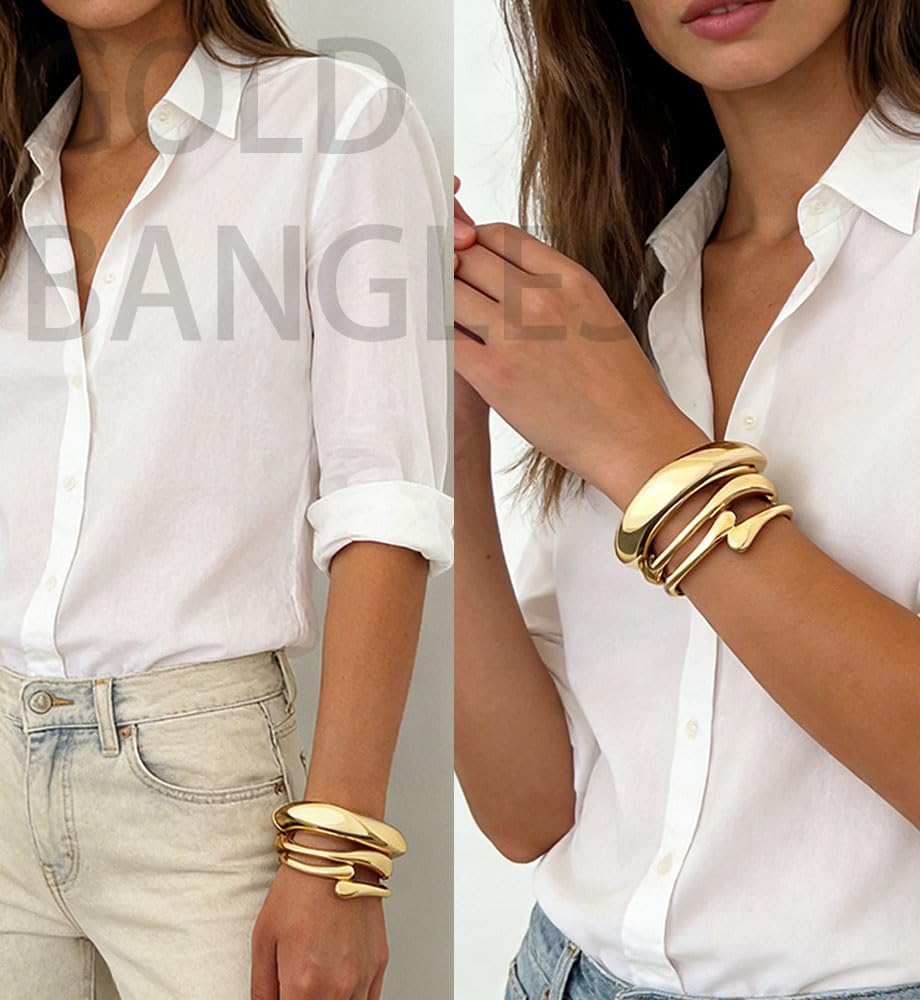
Chunky
$13.99
In stock on Amazon
Check price on AmazonPremium Tier: Solid 10k and 14k Gold Bangles ($300–$1,500+ per piece)
At $400–$1,500 for a simple solid 14k gold bangle, the math looks different on day one. It reframes completely over a ten-year horizon — and especially when you factor in metal value.
As of May 2026, spot gold is trading in the range of $3,200–$3,400 per troy ounce. A solid 14k gold bangle weighing 8 grams contains approximately 4.7 grams of pure gold — roughly 0.15 troy ounces — representing a melt value in the $480–$510 range at current spot. A 10-gram piece at 14k carries roughly $600 in intrinsic metal value. This does not mean you recoup your purchase price on resale — fabrication, design, and retail margin mean you paid above melt, as with any manufactured good. But it does mean the piece holds a floor value that a plated bangle categorically does not. The GIA’s educational resource “Gold Jewelry Alloys” reinforces this explicitly: the metal-value conversation is only meaningful for pieces with substantial gold content by mass.
Vogue’s bangle editorial coverage (“The Best Gold Bangles to Buy Right Now”) frames solid gold anchor pieces as the items that give a stack its identity over time — the piece that photographs consistently across years, weathers daily wear without cosmetic change, and becomes associated with the wearer. For milestone-gift buyers and inheritance-minded purchasers, this floor value and permanence is the entire point. A solid 14k bangle given as a push present or anniversary gift carries a financial and sentimental dimension that a $20 plated piece simply cannot.
Hallmarking is non-negotiable at this tier. Solid U.S.-made gold should carry a karat stamp (10K, 14K, 18K) and a maker’s mark. If a piece is represented as solid gold but carries only a “GP” (gold plate) stamp or no stamp at all, it is not solid gold. Harper’s Bazaar’s bracelet coverage and The Knot’s gold-filled explainer both emphasize hallmark literacy as the single most transferable skill for building a jewelry wardrobe across price points.

PAVOI
$16.95
In stock on Amazon
Check price on AmazonBuilding a Practical Stack: The Mixed-Tier Framework
The practitioners who build stacks best — personal stylists, bridal consultants, jewelry curators — don’t commit to a single price tier. They layer strategically across all three.
Anchor piece (1–2 bangles): Solid 10k or 14k gold, simple profile, hallmarked and authenticated. This is the piece that stays on the wrist, weathers daily wear, and becomes the stack’s identity. Expect to spend $300–$800 here.
Workhorse layer (2–3 bangles): Gold-filled pieces from reputable suppliers. The 1/20 gold-by-weight standard per FTC Jewelry Guides ensures meaningful gold content, and the mechanical bond means these pieces hold up to the friction of stack-on-stack wear far longer than any plated alternative. Budget $60–$180 per piece.
Trend and texture layer (2–4 bangles): This is where plated pieces earn their legitimate place. Use them to introduce a texture (hammered, brushed, twisted), a width variation, or a seasonal silhouette you’re not prepared to commit to in solid gold. Rotate freely. Budget $10–$40 per piece and replace without guilt when they wear.
The decision rule is simple: anchor in metal you’d be comfortable inheriting; fill with gold-filled where longevity matters; trend with plated where flexibility is worth more than permanence.
The Hallmark Check You Should Always Run
Regardless of tier, every piece you buy or recommend should be hallmarked — or you should understand clearly why it isn’t.
- Solid gold should carry a karat stamp (10K, 14K, 18K) and ideally a maker’s mark.
- Gold-filled should be stamped “1/20 14K GF” or a similar fractional designation.
- Vermeil is rarely stamped as such, but the underlying sterling silver base should carry a 925 mark.
- Plated fashion bangles may carry “18K GP” (gold plate over an unknown base) or no mark at all. That is not a disqualifying red flag for what the piece actually is — it is simply confirmation of the tier. Read the stamp as information, not as a quality guarantee.
The FTC Jewelry Guides are the governing standard for these definitions in the U.S. market. The GIA’s gold alloy educational materials, The Knot’s consumer explainers, and Harper’s Bazaar’s expert-sourced bracelet coverage all converge on the same practical advice: learn to read hallmarks before you buy, and you will never be surprised by what a piece does — or doesn’t — hold up to over time.
Know what the stamp says. Know what it doesn’t say. Build your stack with eyes open, and the math works in your favor at every tier.