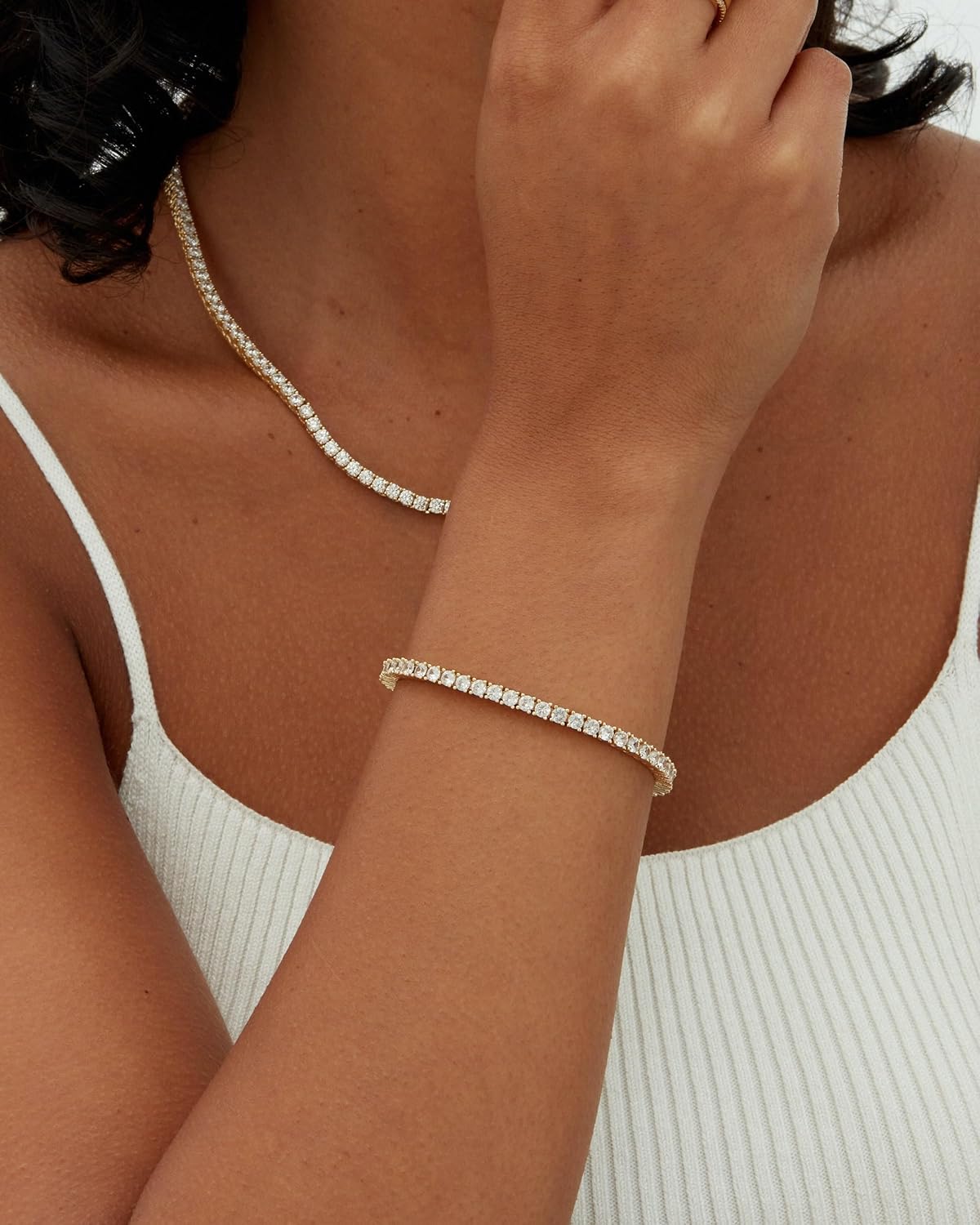
A tennis bracelet is exactly what it sounds like in your imagination: a flexible line of stones set in a continuous row of metal links, wrapping elegantly around the wrist. The name traces back to a 1987 US Open match when player Chris Evert stopped play to retrieve her diamond bracelet — and the style stuck as a jewelry category. Today, most shoppers in the $20–$230 range choose between two diamond simulants — stones engineered to look like diamonds without being diamonds: cubic zirconia, usually abbreviated CZ, a lab-grown zirconium oxide crystal; and moissanite, a silicon carbide crystal also grown in a lab that sits notably higher on the hardness and brilliance scale. Both look dazzling in product photography. What they don’t share is long-term wearability, resale behavior, or price-per-stone economics — and those differences are exactly what this guide is built to clarify.
If you’re weighing a specific bracelet right now — comparing a $35 CZ piece against a $180 moissanite option, or trying to decide whether the upgrade is worth it for a gift — the sections below will give you a concrete decision frame, not just a spec list.
What You’re Actually Comparing: The Core Differences
The comparison breaks cleanly across three properties: hardness, brilliance, and color behavior. Each one maps differently onto how a tennis bracelet performs in real life.
Hardness and Surface Longevity
Hardness is measured on the Mohs scale, where diamond sits at 10. According to the Gemological Institute of America’s moissanite education resource, moissanite scores 9.25 on that scale — making it the second-hardest gemstone material in widespread use. CZ lands at approximately 8.0–8.5. That gap sounds modest, but on an exponential scale it is meaningful: CZ scratches noticeably faster under everyday contact — bag clasps, keyboard edges, other jewelry — while moissanite holds its surface polish through years of continuous wear. Jewelry industry sources including Brides, in their feature “The Difference Between CZ and Moissanite,” describe CZ bracelets developing a “frosted” or “cloudy” appearance within 12–24 months of daily wear, while moissanite stones in comparable settings retain bright facets for several years or more under similar conditions.
At the entry price tier, CZ tennis bracelets in the $20–$50 range deliver the look without the longevity. They are best understood as fashion pieces with a defined horizon.
[[budget-pick]]
Brilliance and Fire
Refractive index governs sparkle. Moissanite’s refractive index runs approximately 2.65–2.69; CZ sits at roughly 2.15–2.18. In practical terms — a distinction Brides makes plainly in “The Difference Between CZ and Moissanite” — moissanite produces more fire (rainbow flash dispersions) than a real diamond, while CZ produces slightly less brilliance than a real diamond. For a tennis bracelet specifically, where dozens of small stones are set in a row and light hits them at constantly changing angles as your wrist moves, this difference is visible in motion. Under store lighting or in product photography, CZ and moissanite look nearly identical to most eyes. In outdoor light or under task lighting, moissanite’s rainbow flash is noticeably more intense.
Mid-tier moissanite bracelets in the $90–$160 range sit in a compelling position here: the stone’s optical performance exceeds what the price implies, and the visual difference from CZ grows more apparent the longer the bracelet is worn in varied lighting.
[[mid-tier-pick]]
Color Behavior and Tint Risk
Color behavior matters more in tennis bracelets than in solitaire rings because the stones sit edge-to-edge, and any tint is multiplied across the row. High-quality CZ in the sub-$100 range is often eye-clean and colorless when new. Moissanite at entry-to-mid price points can carry a faint yellow or green tint under certain lighting — a characteristic the Gemological Institute of America’s moissanite education resource acknowledges in its material science documentation. Premium moissanite, sold under DEF-color grades (borrowing diamond’s grading language), has largely eliminated this issue, but the very lowest-price moissanite tennis bracelets — those approaching CZ price territory — may show visible tint. Buyers prioritizing a clean white appearance on a strict budget may find top-grade CZ more visually consistent than budget moissanite.
Premium moissanite bracelets in the $160–$230 range, particularly those sold with explicit DEF color-grade documentation, resolve this concern and represent the full performance ceiling of the simulant category.
[[premium-pick]]
By the numbers:
| Property | CZ | Moissanite |
|---|---|---|
| Mohs hardness | 8.0–8.5 | 9.25 |
| Refractive index | ~2.15–2.18 | ~2.65–2.69 |
| Typical tennis bracelet price range | $20–$80 | $90–$230 |
| Expected visual lifespan (daily wear) | 1–3 years | 4–8+ years |
Where the Setting and Metal Matter as Much as the Stone
Here’s the piece most CZ-vs-moissanite comparisons skip: for a tennis bracelet, the setting determines whether the stones stay in the bracelet regardless of which stone you choose, and the metal determines whether the piece looks presentable beyond the first year.
Tennis bracelets use three primary setting styles. Prong settings (four or six small metal claws gripping each stone) allow the most light to enter but create small snagging points. Bezel settings (a full ring of metal surrounding each stone) offer the most security and a cleaner silhouette, at the cost of some brilliance. Channel settings (two parallel metal rails cradling a row of stones) sit between the two in both security and sparkle.
At the $20–$80 CZ price tier, most bracelets use base-metal frames — typically brass or copper — plated with rhodium or a gold-tone finish. The plating is typically 1–5 microns thick. Vogue’s editorial “The Best Tennis Bracelets to Shop Now” notes that plating at this thickness begins to wear within six to eighteen months of regular contact, meaning the bracelet’s color-fastness has a similar expiration date to its CZ stones’ surface clarity. Both components age together, which is a useful way to think about entry-level CZ: it is essentially a consumable fashion piece with a 1–3 year horizon.
Moissanite tennis bracelets in the $90–$230 range more frequently appear in sterling silver (often rhodium-plated), gold-filled, or occasionally 10k solid gold frames. Sterling silver provides a meaningful durability improvement over plated base metal; gold-filled construction — a thick bonded gold layer regulated by the FTC to be at least 1/20th gold by weight — lasts substantially longer than plating. Harper’s Bazaar’s roundup “Best Diamond Alternative Jewelry” makes the useful observation that buyers choosing moissanite should evaluate metal quality carefully, since a moissanite stone in a poorly constructed base-metal setting does not deliver the longevity the stone itself is capable of.
Clasp engineering — the most underrated quality signal in any bracelet — deserves specific attention because the tennis bracelet style is historically associated with loss events. A box-tongue clasp with double safety is the construction standard worth insisting on at any price point. At entry-level CZ pricing, buyers should expect simpler fold-over clasps with a single safety click. At moissanite pricing ($90 and up), brands offering box-tongue double-safety clasps are worth prioritizing specifically because a stone-set bracelet that falls off is a complete loss — no stone survives a sidewalk.
How to Match the Purchase to the Use Case
This is where the decision frame becomes concrete. Consider the following four scenarios:
Gift for a teenager or young adult who wears jewelry casually: CZ in a rhodium-plated silver or gold-tone base-metal setting in the $25–$60 range is the rational call. The aesthetic is indistinguishable in photos and social settings, the risk of loss or damage is elevated, and replacement cost is low. The Knot’s buyer’s guide “What Is Moissanite?” makes the straightforward point that moissanite’s durability premium is only captured when the piece is worn consistently over multiple years — which requires the owner to value and protect it. For a recipient who may leave it on a gym locker shelf, CZ is the appropriate tier.
Everyday personal wear for someone who keeps jewelry on through workouts, dishwashing, and sleep: Moissanite wins this scenario clearly. CZ under abrasive daily conditions loses its surface reflectivity faster than most buyers expect — reports of clouding are almost uniformly from people who wore their CZ bracelets the way you’d wear a watch, without removing them for physical activity. Moissanite’s hardness gives it genuine resistance in those conditions. Budget $120–$200 and prioritize a sterling silver or gold-filled setting with a box-tongue clasp.
Milestone gift — graduation, anniversary, push present — where the piece needs to photograph beautifully and feel meaningful: If the emotional context is high and the recipient will wear the piece on special occasions rather than daily, CZ in a well-constructed sterling silver setting ($50–$80) can serve the occasion without looking lesser in the moment. Alternatively, a moissanite bracelet at $150–$230 allows the giver to describe the piece honestly as a durable, lab-grown gemstone — which lands differently in a gifting context than “it’s cubic zirconia.” The Knot’s moissanite buyer’s guide notes that moissanite’s position in the market has shifted significantly, and many recipients now understand it as a considered choice rather than a substitute.
Stacking piece to layer over existing fine jewelry: Here the question is metal compatibility, not stone choice. CZ at entry pricing often uses yellow-gold-toned plating that doesn’t match white gold or platinum stacks cleanly. A moissanite bracelet in rhodium-plated sterling reads as a credible white-metal piece and photographs well alongside solid 14k white gold. If you’re building a wrist stack where one anchor piece is a real diamond or solid gold bracelet, a moissanite companion is a far better aesthetic match and will hold its surface long enough not to look visibly cheaper over time.
Authentication, Labeling, and What to Watch For When Buying
The FTC requires that lab-grown stones be disclosed as such, and that simulant language be used for stones not compositionally identical to the natural stones they resemble. CZ must be labeled as “cubic zirconia” or “CZ” — not “diamond simulant” without qualifier. Moissanite has its own distinct identity and is typically sold under that name without diamond-adjacent language.
What actually goes wrong in the sub-$230 market: some sellers list stones as “moissanite” when they are selling CZ, because moissanite commands higher prices. A simple field test — a thermal conductivity probe, available for under $30 from jewelry supply retailers — distinguishes moissanite from CZ reliably, because moissanite conducts heat differently than CZ does. For gift purchases from established retailers with clear return policies, this test is rarely necessary. Buyers sourcing from marketplace sellers at unusually low “moissanite” prices — $40–$60 for a bracelet described as moissanite — should approach with skepticism.
Harper’s Bazaar’s “Best Diamond Alternative Jewelry” roundup recommends purchasing from retailers who provide documentation or certification for moissanite stones. Branded moissanite lines such as Charles & Colvard come with a certificate of authenticity and a limited lifetime warranty on the stone itself. At the bracelet level this documentation is less common than in ring settings, but reputable brands in the $150–$230 tier typically provide at minimum a product description with clear stone-origin language.
Brides, in “The Difference Between CZ and Moissanite,” also notes that reputable retailers selling moissanite will typically specify the color grade — D, E, or F — and that absence of any color-grade language on a “moissanite” listing is worth treating as a flag for further scrutiny.
The Decision Rule
If you’re still deciding, here’s the plain-language version:
- Under $80, gift or fashion use, risk-tolerant: Buy CZ. You’ll get the look for the moment. Expect 1–3 years of clear brilliance with occasional wear; less with daily wear.
- $90–$230, daily wear, gift with longevity intent, or stacking alongside real gold: Buy moissanite in a sterling silver or gold-filled setting with a box-tongue double-safety clasp. The stone will outlast any plating, so make sure the metal matches the stone’s durability tier.
- The $70–$90 middle zone: This is the only genuinely difficult range. Some brands carry sterling-set CZ options here with reasonable construction; a few moissanite entrants undercut the market with pieces at $85–$100 using base-metal settings, which negates the stone’s durability advantage entirely. At this price point, evaluate the metal and clasp more carefully than the stone.
The stone choice matters less than the construction tier it arrives in. A well-set CZ in sterling silver will outlast a moissanite stone in a 1-micron-plated base-metal frame. Build from the setting outward, then choose your stone.